Legacy · Mechanical validation · Material
Itumbiara material — creep compliance
Shared mechanical anchor for the cases with aging (Fig. 6, slabs, plane ΔT, torsion, Hiramatsu on strains). The Zocher/SLS cases use another material — see each Zocher case page.
Article: Part I · DOI 10.70271/rirc.v1n2a007.
Creep and relaxation
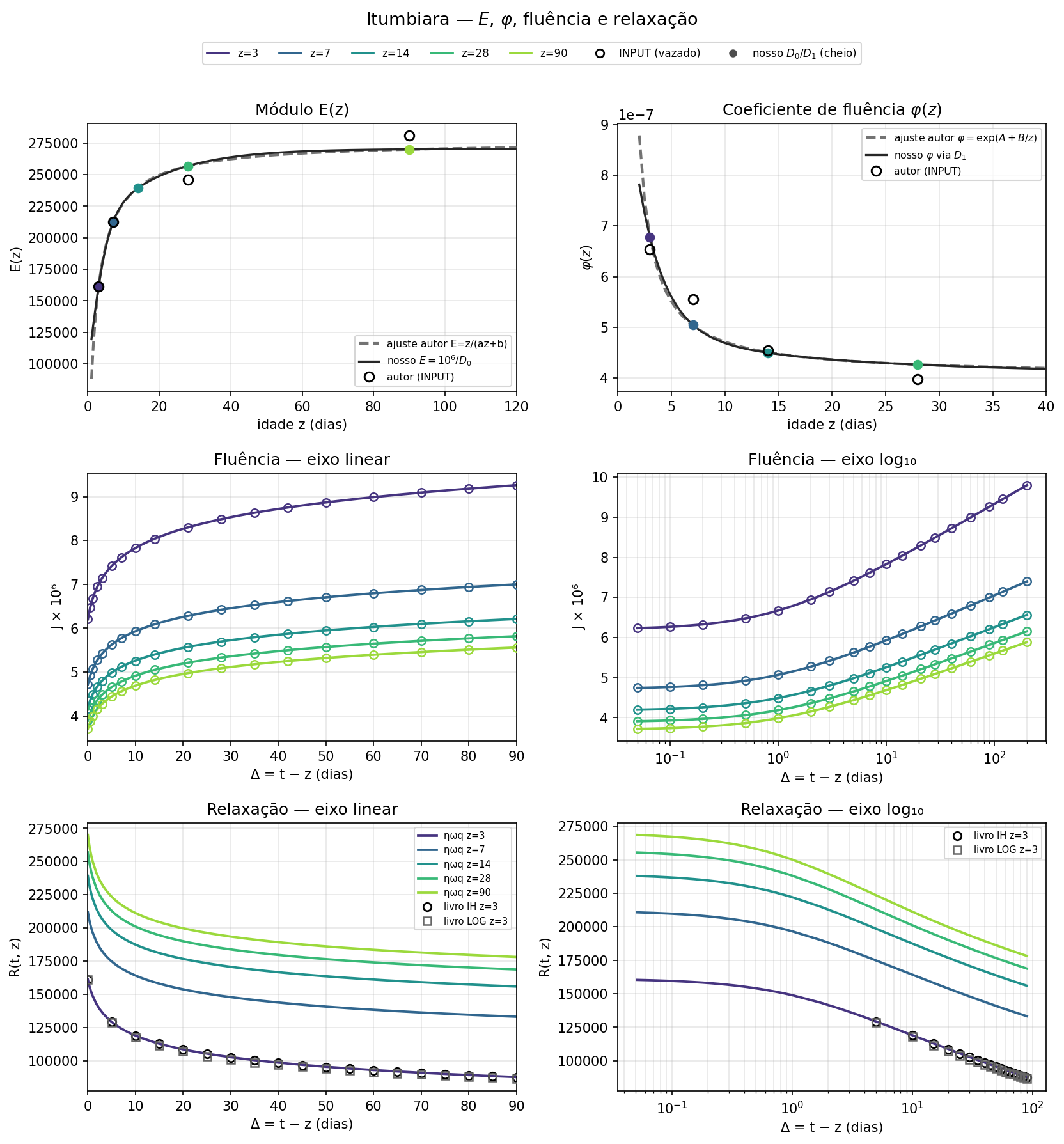
Fitting report and property summary (origin of the coefficients used on the portal): itumbiara_relatorio.pdf.
Notation
| Symbol | Quantity |
|---|---|
| Thermal diffusivity | |
| Degree of hydration | |
| Thermal expansion | |
| Shift factor (Arrhenius) — not diffusivity | |
| Creep compliance |
Two layers of the same concrete
1) Empirical model (Table 1)
| Quantity | Form |
|---|---|
| Modulus | with , |
| Creep coefficient | with , |
| Compliance |
Useful to situate the origin; not the form discretized by the incremental algorithm.
2) Rheological model (Tables 3–4) — anchor
with Kelvin units and .
| Term | |||||
|---|---|---|---|---|---|
| 2.416 | 16.063 | ||||
| 2.416 | 16.063 |
With these coefficients, and .
Spectrum — ref_itumbiara_espectro_kelvin.csv:
| (d) | ||
|---|---|---|
| 1 | 0.3099 | |
| 2 | 0.7619 | |
| 3 | 1.873 | |
| 4 | 4.604 | |
| 5 | 11.32 | |
| 6 | 27.82 | |
| 7 | 68.39 | |
| 8 | 168.1 | |
| 9 | 413.3 | |
| 10 | 1016 | |
| 11 | 2497 |
Constants: ; .
Public files
- ref_itumbiara_espectro_kelvin.csv
- ref_itumbiara_D0_D1_E.csv
- ref_itumbiara_J_z3.csv
- ref_itumbiara_J_z28.csv
- ref_itumbiara_coefs_exp2.csv — book scale; do not use as anchor without the units note
Anchor: Table 3 in MPa (and tabulated ). “First-hand” conversions from the Itumbiara book may differ by ~2 %.
Package
itumbiara_material() in irc-creep.