Legacy · Mechanical validation · §9.2
Restrained slab (foundation)
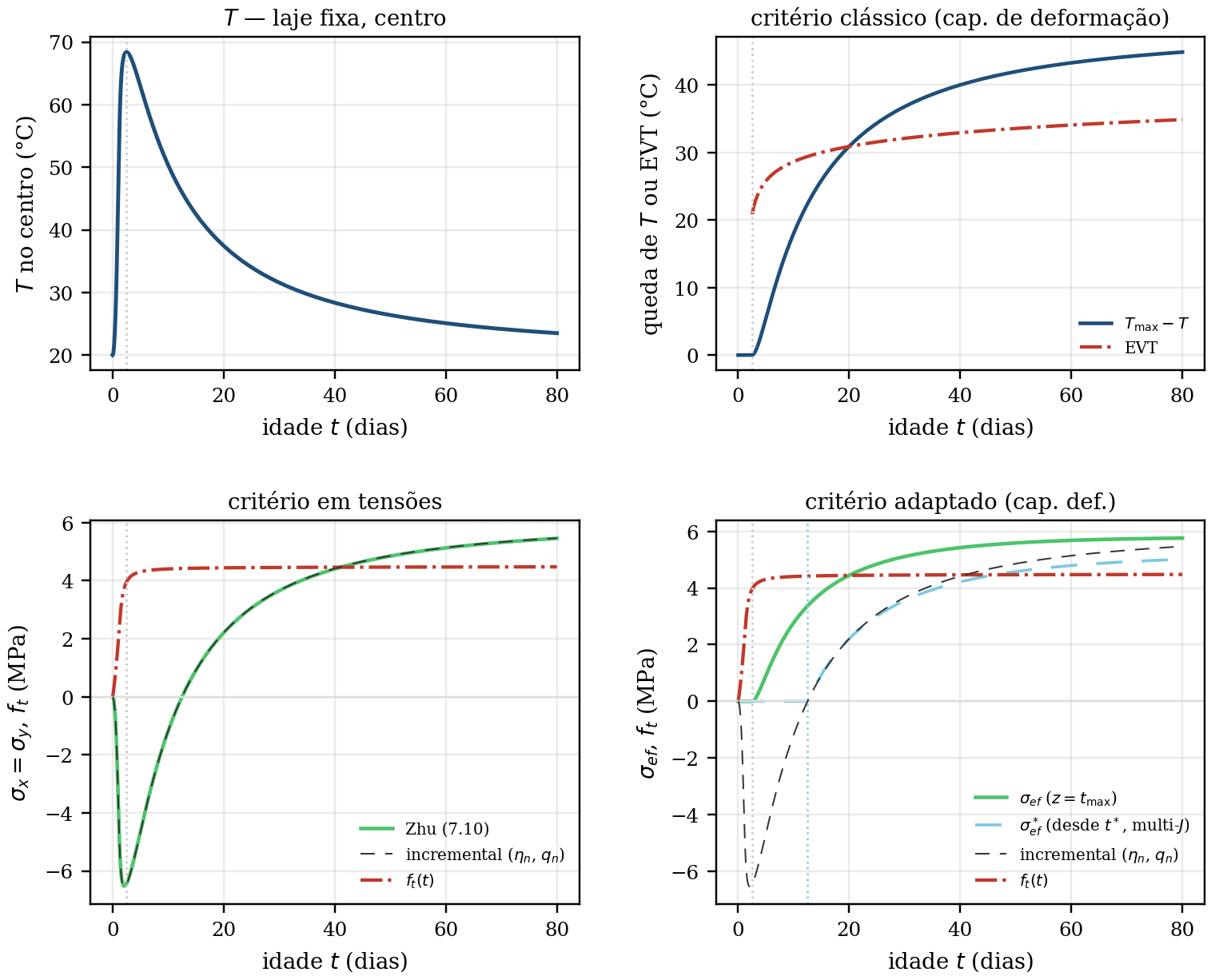
Slab on ground, Hill-type generation, restraint (Zhu). Comparison of the relaxation coefficient × incremental algorithm. Only case with CSV overlay on the portal.
Article: Part I · DOI 10.70271/rirc.v1n2a007 · §9.2
Material: Itumbiara
Reference figure
Data sheet
| Item | Value |
|---|---|
| Type | Slab on ground (foundation); restraint ; free face |
| Thickness | |
| Reported point | Centre () |
| Initial cond. | |
| 1D conduction | , , → |
| Convection | (faces exposed to air, in the one-dimensional model of the article) |
| Generation (Hill) | ; with , , (time in the Hill law is maturity / equivalent time when ) |
| Maturity (Arrhenius) | , — enters generation and ; not nor |
| Dilatation | |
| Strength | with , , |
| Peak at centre (CSV) | at () |
and enter the degree-of-hydration law , not the dilatation .
Chronological age × equivalent age
In the mechanical algorithm of this case (Zhu and incremental), and depend on chronological age (process time from casting). Arrhenius maturity governs Hill kinetics and the curve; it does not replace in nor in . Replacing by in the material shifts the compression peak (~−6.5 MPa → ~−7.3 MPa) and does not reproduce the CSV.
Canonical thermal history
To validate the viscoelastic solver, use the published history:
The article describes the thermal model in §9.2 (Hill + Arrhenius + convection). The slab_temperature function in the irc-creep package belongs to the free slab (§8.3.5: different thickness, different generation) and does not regenerate this CSV. Anyone who rebuilds with only symmetric convection on both faces of an isolated slab will get faster cooling (~32 °C at 20 d) than the CSV (~37.4 °C); the published history already incorporates coupling to the ground from the original simulation. The IRC mechanical reference always starts from the CSV.
Input files
- ref_laje_fixa_T_centro_media.csv — at centre and mean
- Material: Itumbiara
Output files
| File | Content |
|---|---|
| ref_laje_fixa_centro.csv | Full (includes EVT, , …) |
| ref_laje_fixa_centro_slim.csv | Slim for overlay |
Columns of the full CSV
| Column | Meaning |
|---|---|
tempo[h] |
process time from casting |
idade[d] |
chronological age (= time in days on this mesh) |
T_centro[C] |
temperature at the centre |
teq[d] |
equivalent time (Arrhenius maturity) |
f_t[MPa] |
tensile strength |
sigma_Zhu_K[MPa] |
stress via relaxation coefficient (Zhu) |
sigma_incremental[MPa] |
stress from the , algorithm (IRC reference) |
dT_solic[C] |
thermal drop of the criterion: |
EVT[C] |
capacity in temperature: ; nan until the thermal peak (~2.5 d) — the tension check applies only on cooling |
sigma_ef[MPa] |
“classical” effective stress (effective modulus / strain capacity), §9.2 |
sigma_ef_star_multi[MPa] |
multi-age from |
sigma_ef_star_1J[MPa] |
form with a single |
To validate the viscoelastic solver, idade[d], T_centro[C], sigma_Zhu_K and sigma_incremental suffice. Columns EVT / sigma_ef* are verification criteria of Section 9.2, not input to the incremental algorithm.
Control points (centre)
| Check | Value (CSV) |
|---|---|
| Thermal peak | at |
| Maximum compression (incremental) | around |
| Tension at | (above ) |
Overlay — compare your CSV
The chart loads the IRC reference (sigma_incremental vs age). Subscribers upload their own CSV (columns idade[d] and sigma_incremental[MPa], or sigma_user[MPa]). Parsing is in the browser; the file is not sent to the server.